A Reflection on My own Work: Where am I now?
Looking back on my years as a poet and writer, there is a deep satisfaction in seeing the work I have nurtured come to life. My research into Robert Tannahill, the discovery of his connections with Irish song, and the close reading of his lyrics and letters were more than an academic pursuit—they were a way of inhabiting the music, the emotion, and the humanity behind the words.
As a poet, I continue in that spirit, attentive to the rhythms of language, the subtle power of song, and the ways we express our shared human experience. These moments of creation, of careful listening and observation, are my own: untouched by the envy or malice of others, preserved in the permanence of the written word and the living act of poetry.
There is a quiet joy in returning to this work, in celebrating its originality and insight, and in knowing that, despite challenges, it remains intact—an enduring reflection of curiosity, care, and the human heart.
Jim Ferguson, Jan 2026
Essay on Robert Tannahill and Robert Burns by Jim Ferguson completed Jan 2024
Title: Tannahill and Burns: A Politics of Archetype in Literary Art
click on title or image below to access essay in Glasgow Review of Books
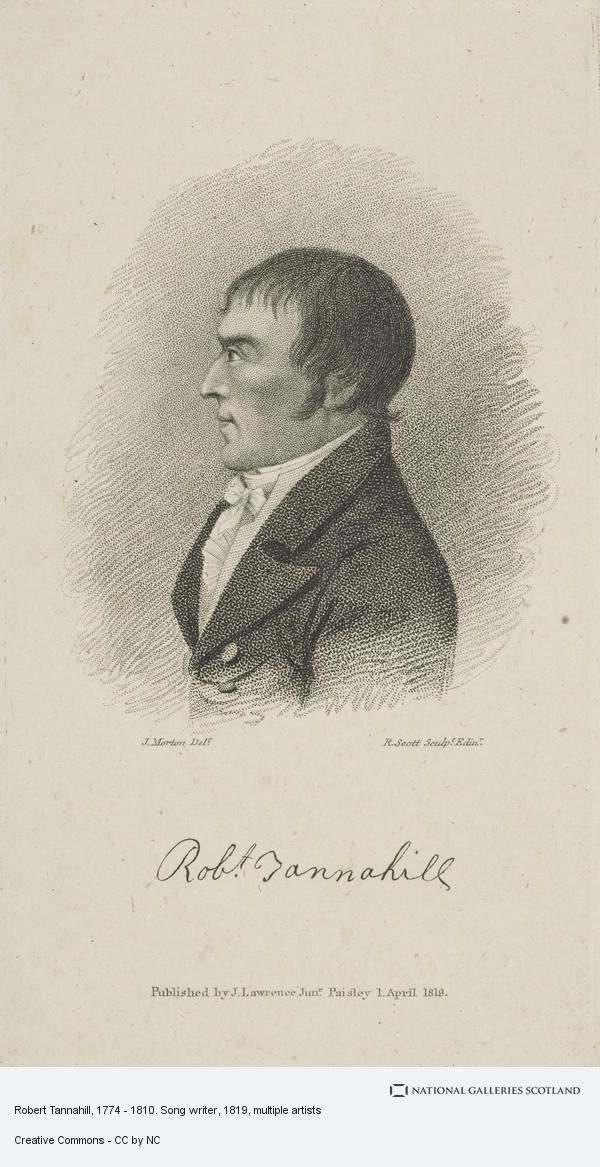
Robert Tannahill 1774-1810
Below is a link to Tannahill's Jacobite version of the song 'Hielan Laddie'. The tune was well known to James Hogg (1770-1835). There are several versions of this tune with different words, it has been transmitted through the folk tradition down the generations and is presently popular as a sea-shanty linking Scotland and Canada. Authorship of the words sang here was attributed to Tannahill by his friend R. A. Smith (1780-1829) and the lyrics appear in 'The Scottish Minstrel' of 1822 which Smith compiled and edited.
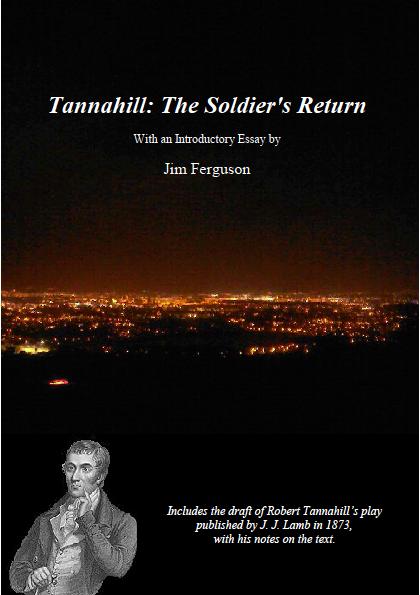
Robert Tannahill was born in Paisley on 3rd June 1774. He worked as a weaver for most of his life, starting as an apprentice to his father around the age of twelve. Best known as a song-writer, he wrote around 100 songs between 1800 and 1810, there were also poems and one play, 'The Soldier's Return'. In 1805 he was a founding member and Secretary of the Paisley Burns Club: one of the first formally constituted Burns clubs in the world. I have spent a few years studying Tannahill's life and work, and at certain periods that study became quite intense, particularly between the years 2004 and 2010. I have written extensively on Tannahill and was perhaps the first writer to investigate Tannahill's interest in Thomas Moore (1779-1852) and Irish song. Click the image below to read my essay "Robert Tannahill and Irish Song". Other essays I have written on Tannahill include "War, Empire, Slavery: Radicalism in the work of Robert Tannahill", "An Ecological Circle: Circularity in Tannahill's Song" and "Peace is the Prize: on Tannahill's The Soldier's Return".